Rice Fields and Forest Land in Myoko: Permission and Notification Rules
Many older houses around Myoko stand next to rice fields or a patch of woodland, and some sales include a field or a strip of forest along with the house. This guide is for anyone living overseas who is thinking about that kind of purchase. Land in Japan is not all treated the same way. Farmland needs permission before you can buy it or build on it, and forest land brings a notice you must send to the city after you become the owner.
Everything here comes from official sources: pages published by Myoko City, and the Forestry Agency's page on forest land notices, including its English leaflet. We read them on 27 September 2026. This is general information, not legal advice. Rules and forms change, so check the current pages before you act, and ask the city office or a qualified professional about a particular piece of land.
Farmland: you need permission to buy it
Myoko City says that when farmland is bought, sold, lent or borrowed for farming, the city's Agricultural Committee must give permission. A contract for farmland made without that permission has no legal effect.
One rule has become easier. From 1 April 2023, the Farmland Act dropped the minimum area requirement (10 ares, or 1,000 square metres) that used to apply when someone acquired farmland. The city lists four conditions that still apply when you acquire farmland:
- Use all of it: you must farm all the farmland you own or rent, and farm it efficiently.
- Companies: a company must meet the conditions for a qualified agricultural corporation.
- Regular farm work: you or a member of your household must work on the farm regularly, as a rule for 150 days or more a year.
- Fitting in with the area: your use must not get in the way of how the farmland around it is used.
The 150-day condition is worth thinking about honestly. If you spend most of the year overseas and picture the field as a large garden, talk to the Agricultural Committee office before you agree to anything. If you inherit farmland rather than buy it, the city provides a separate notice form for inheritance under Article 3-3 of the Farmland Act.
Building on farmland: conversion permission
Using farmland for something other than farming is called conversion. The city says conversion needs permission under the Farmland Act. This applies when owners convert their own land, and also when the land is sold or leased so that someone else can convert it. Converting farmland without permission can lead to penalties.
A second layer sits on top of this. Under the law on agricultural promotion areas, Myoko City protects good farmland by placing it in a designated farmland zone. Inside that zone, development such as preparing a building plot, putting up a building or making a storage yard is strictly limited, and as a rule it is not allowed.
The land can only be built on if it is first taken out of the zone. The city says this is possible only when all six conditions are met. The first is that there is no other suitable land outside the zone. Making an application does not mean it will be approved. The change needs a public notice, a period when the draft plan is open for inspection, and talks with the prefecture and the people with rights in the land, so it takes time. The city asks you to talk to its Agriculture and Forestry Division first.
Farmland outside the zone is locally called "white land" (shiroji). The zone's limits on development do not apply there, but you still need conversion permission and the other applications for development.
There is one local point to know. A national irrigation project covering the Sasagamine Dam and its main channels was declared complete in the 2026 fiscal year. The city says that, as a result, farmland inside the area served by the project cannot be taken out of the zone until the end of the 2034 fiscal year (March 2035). It asks you to check with the city or the local land improvement district whether a plot falls inside that area.
Forest land: tell the city within 90 days
The Forestry Agency says that anyone who newly acquires forest land must notify the mayor of the city, town or village where the land is. This covers individuals and companies, and purchases, inheritance, gifts and company mergers. There is no minimum size, so small plots count too. The notice is due within 90 days of the day you become the owner. Myoko City's own page says the same: when you acquire forest land, you must notify the city.
Which land counts? It is forest covered by the regional forest plan that each prefecture draws up. The agency warns that the category shown in the land register does not settle the question. If the land you acquire is in fact forest, it is likely to be covered. To check a particular plot, ask the forestry section of the prefecture or the city.
There is one exception. You do not need this notice if you have already sent a land transaction notice under the National Land Use Planning Act. That notice applies to larger purchases: 2,000 square metres or more in an urbanisation area, 5,000 square metres in other city planning areas, and 10,000 square metres outside them.
What goes on the forest land notice
The notice asks for:
- the date and the cause of the change of ownership (for example, a purchase or an inheritance);
- the previous owner's name and address;
- your name, address and contact details;
- your nationality;
- where the land is, how big it is, and what it will be used for.
Nationality was added when the form changed on 1 April 2026. From the same date, an owner who lives outside Japan must attach a separate sheet with a contact in Japan. For a company, the form asks for the nationality of its representative. If most of its officers or voting rights belong to people from one country, it also asks which country.
You attach two things. The first is a map showing roughly where the land is (any map will do). The second is a copy of the land register certificate, or another document that shows you acquired the land, such as the sales contract. Myoko City offers the notice form and a leaflet on the scheme on its page.
Two points are easy to miss. First, with an inheritance the notice is still due within 90 days of the day the inheritance begins, even if the heirs have not yet agreed how to divide the estate. The heirs file as joint owners. Second, the notice is separate from registering the land. You must send it whether or not the land has been registered, and sending it does not prove that you own the land. Registering an inherited property has been a legal duty since 1 April 2024. Heirs must register it within three years of learning that they inherited it.
Cutting trees and clearing forest land
Owning forest land also brings rules on what you do with it. Myoko City says a forest owner who plans to cut trees must tell the city in advance about the felling and about replanting afterwards. The city's forms set the timing: the felling notice goes in between 90 and 30 days before the felling, and a report on the state of the land is due within 30 days after it.
Clearing forest land for development over 1 hectare needs permission from the prefectural governor. The Forestry Agency's leaflet adds that the limit is 0.5 hectares for solar power installations. In protected forests, felling trees and changing the shape of the land both need permission.
A short checklist before you agree to buy
- Ask the agent whether any part of the sale is farmland, and whether any part is forest, whatever the land register says.
- For farmland, contact Myoko City's Agricultural Committee office before signing, and ask whether you can meet the four conditions, including the 150-day farm work rule.
- If you hope to build on farmland, ask the Agriculture and Forestry Division whether the plot is inside the designated farmland zone, and whether it is in the Sasagamine irrigation project area.
- For forest land, note the 90-day deadline from the day you become the owner, and arrange a contact in Japan to put on the form.
- Before cutting trees, send the felling notice at least 30 days ahead.
What we could not verify, and therefore left out
The Ministry of Agriculture's own pages on farmland permission refused our automated request on the day, so we used Myoko City's pages, which set out the same rules for this city. The city's PDF guide to farmland procedures and its list of documents for a purchase permission could not be read as text. So we have not listed the documents, how long a decision takes, or any fees. We did not find the penalty amounts for converting farmland without permission, or the deadline for the inherited farmland notice, on the pages we read. We did not check whether any particular plot is farmland, inside the farmland zone, or covered by the regional forest plan. Ask the city about your own land.
Related guides
- Buying Property in Japan as a Foreigner: An Australian Guide
- Two Property Registration Deadlines Overseas Owners in Japan Now Face
More from the Journal
Browse every guide in the Myoko Kogen Journal. This guide is general information, not legal or tax advice.
Sources
All URLs retrieved 2026-09-27.
- Myoko City — 農地法等に関すること(制度・各種様式) (farmland: Agricultural Committee permission for buying, selling and renting; contracts without permission are void; minimum area removed from 1 April 2023; four remaining conditions; conversion needs permission and carries penalties; forms, including the Article 3-3 inheritance notice): https://www.city.myoko.niigata.jp/docs/1021.html
- Myoko City — 農業振興地域制度について (designated farmland zone, limits on development, the six conditions for removal, the process, white land, and the Sasagamine irrigation project area): https://www.city.myoko.niigata.jp/docs/2205.html
- Myoko City — 森林の土地の所有者届・伐採届について (forest land notice, felling notice and report, governor's permission for development over 1 hectare, forms): https://www.city.myoko.niigata.jp/docs/288.html
- Forestry Agency — 森林の土地の所有者届出制度 (who must notify, 90 days, which land, exception, what the form asks, changes from 1 April 2026, attachments, relation to registration): https://www.rinya.maff.go.jp/j/keikaku/todokede/index.html
- Forestry Agency — Overview of the Forest Land Ownership Notification System (English leaflet: no minimum size, inheritance, land transaction notice thresholds, felling and development rules, attachments): https://www.rinya.maff.go.jp/j/keikaku/todokede/attach/pdf/index-16.pdf
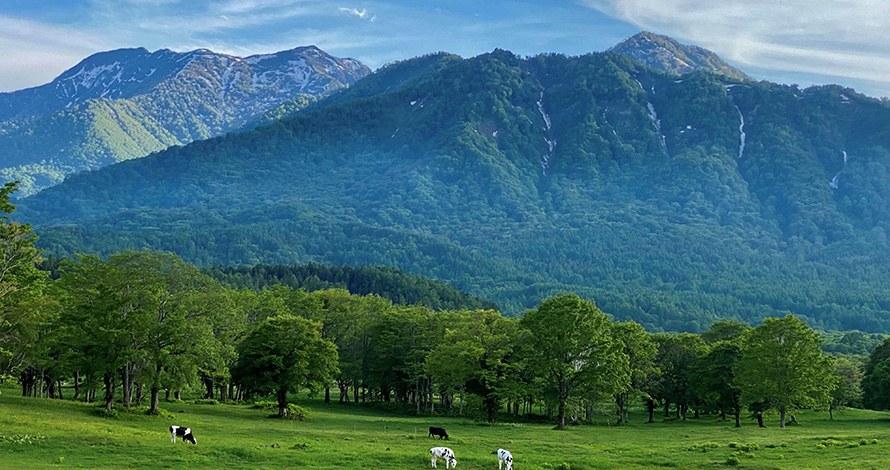
Header photo: “Cattle grazing on the green Sasagamine highland with forested mountains behind” (Ministry of the Environment, Japan / 環境省), https://www.env.go.jp/nature/nationalparks/list/myoko-togakushi-renzan/spot/. Edited (cropped and resized) for use as the header image on this page. Used under the Public Data License (PDL) Version 1.0.
