Getting to Myoko from Australia: Flights, Trains, Transfers
Myoko Kogen sits in Myoko City, Niigata Prefecture, on the Niigata side of the mountains that separate it from Nagano. For Australians who already know Niseko or Hakuba, the first question is usually the same one: how hard is it to actually get there, with skis, in winter, without a car?
The honest answer is that Myoko is one of the easier Japanese snow regions to reach from Australia — but only if you organise the last hour properly. What follows is a leg-by-leg walk-through, every number traced to an operator or government page we opened on 18 September 2026. Japanese timetables and fares change with each seasonal revision, so treat this as a planning framework and check the operator before booking.
The shape of the journey
There are four legs, set out below in order: Australia to Tokyo by air, airport to central Tokyo by rail, Tokyo to Joetsu-Myoko by Shinkansen, and the last hour by local train, bus, taxi or hire car.
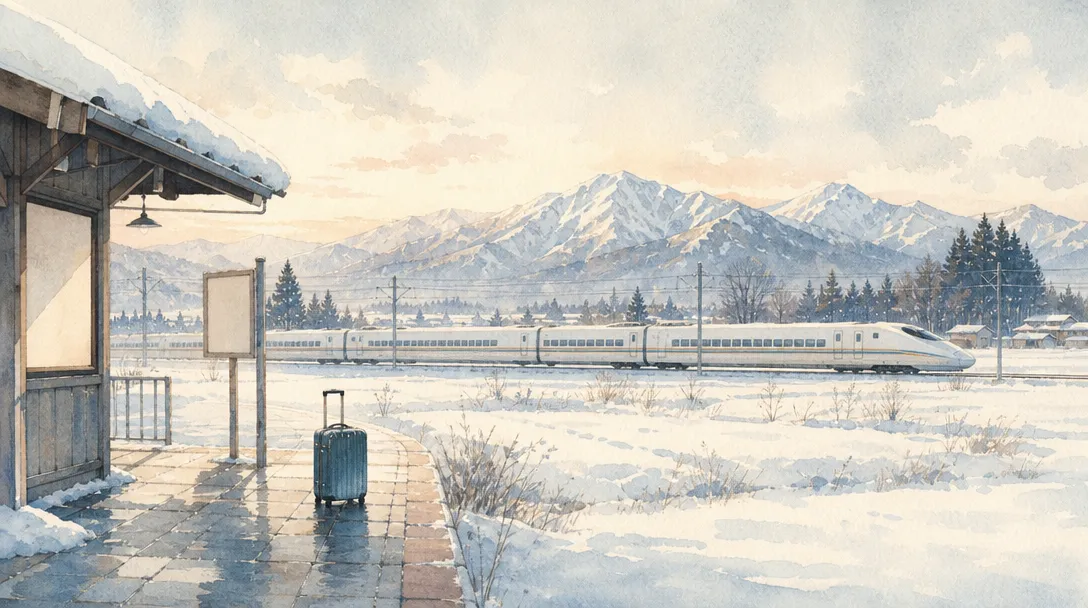
Leg three is the one that makes Myoko competitive. The Myoko Tourism Board states the fastest Hokuriku Shinkansen journey from Tokyo Station to Joetsu-Myoko Station is 1 hour 50 minutes (Myoko Tourism Board, https://myokotourism.jp/access/).
Leg 1 — Flying from Australia
Tokyo has two international gateways: Haneda, which is much closer to the city, and Narita. Both matter, because which one you land at changes the shape of your first day in Japan.
Non-stop services between Australia and Tokyo are operated by several carriers, and frequencies shift between the northern winter and summer schedules. We have deliberately not quoted frequencies or flight numbers here: on 18 September 2026 the airline websites we attempted to open (Qantas, JAL and ANA passenger pages) returned errors or timed out, so nothing could be verified to our own standard. Check the carrier directly before you plan around a particular departure day.
One route we could verify from the airline group's own newsroom: ANA announced a direct Tokyo–Perth service, stating that "the flight will be based out of Narita International Airport", with the service beginning in September 2019 (ANA Holdings media release dated 26 December 2018, https://www.anahd.co.jp/group/en/pr/201812/20181226.html). Western Australian buyers should assume a Narita arrival unless told otherwise, and plan the Tokyo transfer accordingly.
A practical note: an arrival before about midday leaves enough of the day to reach Myoko that evening; a late-afternoon arrival usually means a night in Tokyo. Budget for that extra night.
Leg 2 — Airport to central Tokyo
From Haneda, the Tokyo Monorail reaches Hamamatsucho in 13 minutes, and the operator notes that "The Tokyo Monorail and the Yamanote Line run on an average of every five minutes" (Tokyo Monorail, https://www.tokyo-monorail.co.jp/english/). From Hamamatsucho you join the Yamanote Line for Tokyo Station. Haneda Airport's own access portal lists the monorail, rail and bus options by terminal (Haneda Airport, https://tokyo-haneda.com/en/access/index.html).
From Narita, the Keisei Skyliner connects "Narita Airport to the heart of Tokyo in as little as 36 minutes" (Keisei Electric Railway, https://www.keisei.co.jp/keisei/tetudou/skyliner/us/index.php). Narita Airport's access page also lists rail and public bus options (Narita International Airport, https://www.narita-airport.jp/en/access/).
Either way, you want Tokyo Station, where the Hokuriku Shinkansen begins.
Leg 3 — The Hokuriku Shinkansen to Joetsu-Myoko
Joetsu-Myoko is the Shinkansen station for the region, and the Myoko Tourism Board gives the fastest Tokyo–Joetsu-Myoko time as 1 hour 50 minutes (https://myokotourism.jp/access/). Not every service is that quick, so check the timetable for your specific departure rather than assuming the headline figure.
Oversized-baggage rules and reservation requirements vary by train type and season, so confirm the current rule with the operator when you reserve seats.
Leg 4 — The last hour: Myoko Kogen and Akakura
This is where people get caught out, because there are two different rail routes to the same village.
Via Joetsu-Myoko. Echigo Tokimeki Railway runs the Myoko Haneuma Line, which serves ten stations between Naoetsu and Myoko Kogen — including Joetsu-Myoko, Arai and Sekiyama — and connects with JR East at Naoetsu (Echigo Tokimeki Railway, https://www.echigo-tokimeki.co.jp/guide/haneuma-line/). The company was formed to run the conventional lines in the Joetsu region that were separated from JR when the Hokuriku Shinkansen opened in 2015 (https://www.echigo-tokimeki.co.jp/). That separation is the reason this leg is not a JR service — an important detail if you are pricing a rail pass. Current timetables and fare tables are published as downloads on the operator's timetable and fares page (https://www.echigo-tokimeki.co.jp/timetable/).
Via Nagano. The Myoko Tourism Board also describes reaching Myoko Kogen Station by transferring at Nagano Station to Shinano Railway (https://myokotourism.jp/access/). Shinano Railway's fares page shows a passenger fare table revised in March 2026 (https://www.shinanorailway.co.jp/rail-info/fare/), so any older figure you find online is out of date.
From Myoko Kogen Station to Akakura. Myoko City operates municipal bus routes from the station, including an Akakura Line running 18 services a day to the Akakura foot-bath area and a Suginosawa Line also running 18 services a day; a seasonal Myoko Sanroku route operates from 25 April to 3 November (Myoko City, https://www.city.myoko.niigata.jp/docs/892.html). The same page records that children aged 1 to 12 pay half fare, under-1s travel free, and a 50 per cent discount applies to holders of disability certificates. The tourism board notes that timetables change at the start of December for the winter season (https://myokotourism.jp/access/), so the summer and winter sheets are not interchangeable.
The winter direct bus. A seasonal service called the Myoko Kogen Liner, operated by Keinan Bus, links Joetsu-Myoko Station with the Akakura, Shin-Akakura, Ikenotaira and Suginosawa onsen areas with "seamless transfers" (Niigata Prefecture tourism association, https://niigata-kankou.or.jp/traffic/31074). The operating dates shown on that page are from an earlier season (26 December 2020 to 14 March 2021), so the current season's dates and fares must be confirmed with the operator before you rely on it.
Hire cars. The tourism board lists rental car offices at Joetsu-Myoko, Nagano and Naoetsu stations, with daily rates listed from roughly 4,000 to 5,000 yen as of that page (https://myokotourism.jp/access/).
Skis, boards and baggage
Ski and snowboard bags are handled under each airline's sporting-equipment policy, and the allowances, dimensions and fees differ enough between carriers that quoting one set of numbers would mislead you. We could not open the carriers' baggage pages on 18 September 2026, so no figures are given here. Read your own airline's sporting equipment page before you pay for excess.
One point does not depend on the carrier: a ski bag is awkward on a crowded commuter train, and equally awkward on a rural bus. If you are travelling with a family's worth of gear, a hire car or a pre-booked private transfer from Joetsu-Myoko is worth the money.
Entry formalities
Japan's entry paperwork is now largely digital. Japan Customs states that it "requires all passengers entering Japan to submit a Declaration of Accompanied Articles and Unaccompanied Articles in order to prevent terrorism and smuggling", and recommends doing it electronically: after completing your information in Visit Japan Web, "a 2D code including your declaration information will be created". At the airport you "hold the 2D code and your IC passport over the scanner of electronic declaration terminal placed at the customs inspection area" to use the electronic gate (Japan Customs, https://www.customs.go.jp/english/passenger/declaration/declaration_app.html).
The same page records that, following "the unification of 2D codes for immigration and customs declarations on Visit Japan Web on January 25th, 2024", codes produced by the older Customs Declaration App no longer work — useful to know if you have an old app on your phone from a previous trip. Paper form C-5360 remains available in 13 languages. Visit Japan Web itself is run by Japan's Digital Agency (https://services.digital.go.jp/en/visit-japan-web/).
Register before you fly, while you still have reliable wi-fi and your passport in front of you.
Driving in Japan: permits and winter tyres
If you intend to drive around Myoko, the permit question has one right answer. The Tokyo Metropolitan Police Department states that "Only international driving permits issued by a signatory to the 1949 Geneva Convention in conformity with the Convention's provisions are recognized as valid", and that permits issued under other treaties, including the 1969 Vienna Convention, are not accepted (https://www.keishicho.metro.tokyo.lg.jp/multilingual/english/finding_services/faq/drivers_license/drivers_license01.html). The police direct enquirers to "the list of the contracting states of the 1949 Geneva Convention" to confirm status (https://www.keishicho.metro.tokyo.lg.jp/multilingual/english/finding_services/faq/drivers_license/drivers_license02.html), and publish a wider set of licence FAQs (https://www.keishicho.metro.tokyo.lg.jp/multilingual/english/finding_services/faq/drivers_license/index.html). Organise the permit in Australia before you leave; it cannot be issued in Japan.
Winter equipment is regulated, not optional. NEXCO Central's winter driving guidance warns that you cannot travel on the expressway without winter tyres or chains, and that under a chain regulation, "Even if you are wearing winter tires such as studless tires, you will not be able to run without a tire chain" (https://www.c-nexco.co.jp/en/special/snow/point.html). When you book a hire car for a snow-season trip, confirm in writing that it comes with winter tyres, and ask whether chains are included.
How Myoko compares with Niseko and Hakuba
On travel time alone, three points are worth holding side by side, all taken from official or operator sources.
- Myoko: Tokyo Station to Joetsu-Myoko, fastest 1 hour 50 minutes, plus a local leg of well under an hour (https://myokotourism.jp/access/).
- Hakuba: Hakuba Valley states the quickest route from Tokyo, combining the Hokuriku Shinkansen with an express bus, takes approximately 2 hours 50 minutes (https://www.hakubavalley.com/access/).
- Niseko: requires a second flight to New Chitose. From that airport, the train to Sapporo takes approximately 40 minutes (Hokkaido Airports, https://www.hokkaido-airports.com/rd_newchitose/en/access/). Reaching Niseko itself means a rapid service to Otaru of about 72 minutes plus a local train of about 90 minutes, or a seasonal ski bus — listed at 6,000 yen one way and 10,000 yen return, operating 13 December 2025 to 22 March 2026 (Niseko United, https://www.niseko.ne.jp/en/niseko/niseko-access/).
In other words, Myoko and Hakuba are both same-day propositions from a morning Tokyo arrival. Niseko adds a domestic flight and a longer ground transfer. For an owner who plans to visit several times a season rather than once a year, that difference compounds.
What to check before you book
- The exact Shinkansen service, not the headline "fastest" time.
- Whether the Myoko Kogen Liner is running on your dates, and its current fare.
- The winter bus timetable, which changes from the start of December.
- Your airline's sporting-equipment rules, in writing.
- Your International Driving Permit, organised in Australia.
- Visit Japan Web registration, completed before departure.
All journey times and fares above reflect what the listed operators and authorities published on 18 September 2026. Japanese timetables are revised at least annually, so re-check before you commit to dates.
Related guides
- Myoko Ski Areas and Snowfall: What the Official Records Show
- Buying Property in Japan as a Foreigner: An Australian Guide
Looking at property in Myoko?
See the homes currently listed on Myoko Property, or send us your questions in English. This guide is general information, not legal or tax advice.
Sources
All URLs accessed 2026-09-18.
- Myoko Tourism Board — Access: https://myokotourism.jp/access/
- Myoko City — Municipal buses: https://www.city.myoko.niigata.jp/docs/892.html
- Echigo Tokimeki Railway — Myoko Haneuma Line: https://www.echigo-tokimeki.co.jp/guide/haneuma-line/
- Echigo Tokimeki Railway — Timetables and fares: https://www.echigo-tokimeki.co.jp/timetable/
- Echigo Tokimeki Railway — Company site: https://www.echigo-tokimeki.co.jp/
- Shinano Railway — Fares: https://www.shinanorailway.co.jp/rail-info/fare/
- Shinano Railway — Rail information index: https://www.shinanorailway.co.jp/rail-info/
- Niigata Prefecture tourism association — Myoko Kogen Liner: https://niigata-kankou.or.jp/traffic/31074
- Tokyo Monorail (English): https://www.tokyo-monorail.co.jp/english/
- Haneda Airport — Access: https://tokyo-haneda.com/en/access/index.html
- Narita International Airport — Access: https://www.narita-airport.jp/en/access/
- Keisei Electric Railway — Skyliner: https://www.keisei.co.jp/keisei/tetudou/skyliner/us/index.php
- Japan Customs — Declaration of Accompanied Articles and Unaccompanied Articles: https://www.customs.go.jp/english/passenger/declaration/declaration_app.html
- Digital Agency — Visit Japan Web: https://services.digital.go.jp/en/visit-japan-web/
- ANA Holdings — media release, 26 December 2018: https://www.anahd.co.jp/group/en/pr/201812/20181226.html
- NEXCO Central — Guide for driving on snowy roads: https://www.c-nexco.co.jp/en/special/snow/point.html
- Hokkaido Airports — New Chitose Airport access: https://www.hokkaido-airports.com/rd_newchitose/en/access/
- Niseko United — Getting to Niseko: https://www.niseko.ne.jp/en/niseko/niseko-access/
- Hakuba Valley — Access: https://www.hakubavalley.com/access/
- Tokyo Metropolitan Police Department — FAQ, driving with an IDP obtained overseas: https://www.keishicho.metro.tokyo.lg.jp/multilingual/english/finding_services/faq/drivers_license/drivers_license01.html
- Tokyo Metropolitan Police Department — FAQ, 1949 Geneva Convention signatories: https://www.keishicho.metro.tokyo.lg.jp/multilingual/english/finding_services/faq/drivers_license/drivers_license02.html
- Tokyo Metropolitan Police Department — Driving licence FAQ index: https://www.keishicho.metro.tokyo.lg.jp/multilingual/english/finding_services/faq/drivers_license/index.html
