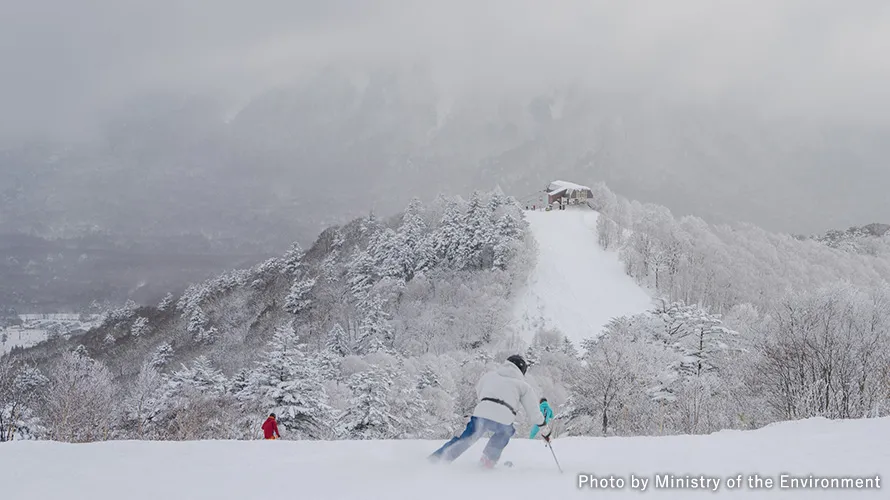
Myoko Ski Areas and Snowfall: What the Official Records Show
Myoko Kogen sits in Myoko City, Niigata Prefecture, on the Sea of Japan side of Honshu. If your mental model of a ski destination is an Australian one — one lift company, one mountain, one pass — Myoko will take some adjusting to. Myoko City's own website lists nine separate ski areas inside the municipality (Myoko City, https://www.city.myoko.niigata.jp/docs/106.html). Most are independent operators with their own tickets, their own opening dates and their own personality.
What follows is a resort-by-resort summary using only figures published by the operators themselves or by the Niigata Prefecture Tourism Association, followed by the question Australians ask first: how much snow actually falls? All figures were checked on 18 September 2026. Where a date belongs to last season (2025-26) rather than an announced plan for 2026-27, it is labelled.
The snow, according to the Japan Meteorological Agency
Resort marketing is not evidence. The Japan Meteorological Agency (JMA) runs an automated station at Sekiyama, inside Myoko City, and publishes both its 1991–2020 climate normals and its all-time extremes.
The Sekiyama normals give an annual total snowfall of 1,061 centimetres — that is, a little over ten metres of snow accumulating across a typical season — and a normal annual maximum snow depth of 204 centimetres (JMA, https://www.data.jma.go.jp/stats/etrn/view/nml_amd_ym.php?prec_no=54&block_no=0998&view=p1). The monthly breakdown of that snowfall normal is December 220 cm, January 385 cm, February 291 cm, March 159 cm and April 18 cm. Normal monthly maximum depth peaks in February at 192 cm, with January at 172 cm and March still at 149 cm.
The extremes are more striking. Over the period of record (November 1980 to August 2026), the deepest snow measured at Sekiyama was 362 cm on 1 March 1984, followed by 356 cm on 8 January 2006 and 351 cm on 7 January 1985. The list is not merely historical: 347 cm was recorded on 3 February 2012 and 311 cm on 23 February 2022 (JMA, https://www.data.jma.go.jp/stats/etrn/view/rank_a.php?prec_no=54&block_no=0998&year=&month=&day=&view=). The heaviest single month on record accumulated 650 cm in January 1985, with 564 cm in January 2011 and 563 cm in January 2012 showing that big months are still happening (JMA, https://www.data.jma.go.jp/stats/etrn/view/rank_a.php?prec_no=54&block_no=0998&year=&month=&day=&view=a2).
Two caveats worth holding onto. First, Sekiyama is a valley-floor station, not a summit — the ski areas above it run several hundred metres higher, and depth increases with altitude. Second, Myoko is not a cold, dry place in absolute terms: the same JMA normals give an annual mean temperature of 11.9°C and a January mean of 0.0°C, with annual precipitation of 1,924.4 mm (JMA, https://www.data.jma.go.jp/stats/etrn/view/nml_amd_ym.php?prec_no=54&block_no=0998&view=). The snow is a maritime snow driven by cold air crossing the Sea of Japan, and it is famously abundant rather than famously light.
For a point of comparison you already know: the Bureau of Meteorology notes that Australia's peak snow season usually falls between June and August, that peak snow depth at Spencers Creek exceeded 230 cm in both 2017 and 2022, that roughly a metre is close to the average snow depth across seasons from 1954 to 2022, and that peak depths there have been declining by about 0.35 cm per year over that period (Bureau of Meteorology, https://media.bom.gov.au/social/blog/2749/how-climate-drivers-affect-australias-snow-season/). Myoko's normal annual snowfall total is roughly ten times the average Australian peak depth — different measures, but the order-of-magnitude difference is the point.
Akakura Onsen
The largest and oldest of the village-based areas, spread across the slopes directly above the Akakura hot-spring town. The Niigata Prefecture Tourism Association lists it at 720–1,500 metres, with 17 courses (50% beginner, 40% intermediate, 10% advanced), a longest run of 2.8 kilometres, a maximum gradient of 43 degrees, and 14 lifts — eight pair, four triple and two quad. Last season it opened on 13 December 2025 with a planned close of 29 March 2026, and an adult one-day ticket was listed at ¥7,000. Night skiing ran 20 December to 15 March, 17:00–21:00, extending to 22:00 on Fridays and Saturdays, with a night ticket at ¥3,500 (Niigata Prefecture Tourism Association, https://niigata-kankou.or.jp/ski/10670).
The town below matters as much as the hill. The Akakura Onsen Tourism Association states the spa was opened in Bunka 13 of the Edo period — 1816 — and describes it as Japan's only domain-operated hot spring (https://akakura.gr.jp/).
Akakura Kanko Resort
Immediately adjacent, and a very different feel: a hotel-anchored resort established in 1937 (Myoko Tourism, https://myokotourism.com/ski-resorts/). Its own website lists nine courses — one beginner, five intermediate and three advanced — served by six lifts plus the six-person Myoko Kogen Skycable gondola, which runs 2,607 metres. The longest single course listed is the 1,700-metre Women's National Sports Festival course; the steepest is Champion A at 32 degrees. Ticket prices for the coming season are published as ¥7,000 adult for one day, ¥5,400 for four hours, ¥12,300 for two days and ¥75,000 for a season pass, with an operating period of 19 December 2026 to 5 May 2027 (Akakura Kanko Resort, https://akr-ski.com/slope/). The prefectural listing gives a slightly different picture — 700–1,500 metres and a 4,500-metre longest descent — presumably measuring a top-to-bottom link rather than a single named course (https://niigata-kankou.or.jp/ski/10677).
Ikenotaira Onsen (Alpen Blick)
The wide, open, family-friendly option. Listed at 759–1,487 metres with 16 courses (35% beginner, 45% intermediate, 20% advanced), a longest run of 2,500 metres, a gentle maximum gradient of 28 degrees, and five lifts. Last season ran 20 December 2025 to 29 March 2026, 8:30–16:30, with adult one-day tickets at ¥6,900, children ¥4,300 and seniors aged 60 and over ¥5,900. Three permanent terrain parks carry more than 20 features (Niigata Prefecture Tourism Association, https://niigata-kankou.or.jp/ski/10671). The resort's own site describes the base as sitting at 800 metres on the flank of Mt Myoko (https://www.alpenblick-resort.com/).
Myoko Suginohara
The big-vertical mountain. Peak 1,855 metres, base 731 metres, a vertical drop of 1,124 metres, 16 courses (40/40/20) and a maximum gradient of 38 degrees, served by four lifts and a gondola (Niigata Prefecture Tourism Association, https://niigata-kankou.or.jp/ski/10676). Its headline number is a longest run of 8.5 kilometres, which the regional tourism body describes as one of the longest in Japan (Myoko Tourism, https://myokotourism.jp/myoko-suginohara/ and https://myokotourism.com/ski-resorts/). Last season ran 13 December 2025 to 29 March 2026. The operator's own ticket page lists a 2025-26 adult one-day pass at ¥8,000 general or ¥7,200 for members, with lift access free for elementary-school children and younger (Prince Snow Resorts, https://www.princehotels.co.jp/ski/myoko/winter/lift/).
Seki Onsen
Small, steep, old-fashioned and much loved. Two lifts — one single chair, one pair — serve four courses across 1,000–1,200 metres, with a longest run of 1.5 kilometres and a maximum gradient of 45 degrees. Last season it opened on 25 December 2025 and planned to run to mid-May 2026, 9:00–16:30, with an adult day ticket of ¥3,900 and children ¥2,900 (Niigata Prefecture Tourism Association, https://niigata-kankou.or.jp/ski/10673). That closing date is not a typo, and it is the single most un-Australian fact in this article.
Arai Mountain Resort
Formerly Lotte Arai Resort, now listed under the name Arai Mountain Resort. Base 320 metres, peak 1,280 metres, 24 courses including ungroomed terrain (25% beginner, 45% intermediate, 30% advanced), a maximum gradient of 46 degrees, two pair lifts, two quads, a gondola and a conveyor. Last season ran 13 December 2025 to 10 May 2026, with First Class day tickets at ¥7,500–9,500 for adults and Economy tickets at ¥5,000–7,500 (Niigata Prefecture Tourism Association, https://niigata-kankou.or.jp/ski/15500).
Madarao Kogen
Just over the boundary in Nagano Prefecture, and usually counted as part of the Myoko orbit. The resort describes itself as a 100% natural-snow area at 1,000 metres, with 51 courses across two linked ski areas and 15 tree-run courses when counted together with the adjoining Tangram Ski Circus — a count the operator claims is among the largest in Japan (Madarao, https://www.madarao.jp/ski/course/treerun).
What an Australian skier will notice
Three things, in order of impact.
Trees. Australian resorts are largely above or at the treeline, and tree skiing is marginal. In Myoko it is a headline product — Madarao's 15 marked tree-run courses exist because the terrain is forested to the summit and the snowpack is deep enough to bury the understorey.
Onsen. Every one of these areas except Arai and Madarao carries a hot-spring name, and that is literal: Akakura, Ikenotaira and Seki are spa villages that happen to have ski lifts, not ski resorts that added a spa.
Season length. The BOM puts Australia's peak season between June and August. Seki Onsen planned to run to mid-May and Arai to 10 May last season, and Akakura Kanko has published 5 May 2027 as its closing date for the coming season. That is a materially longer usable window, which is worth weighing if you are assessing a property's rental potential rather than just your own holidays.
What we could not verify
Several commonly repeated claims were checked and deliberately left out. Seki Onsen's official site (sekionsen.jp) could not be retrieved, so its figures here come from the prefectural listing rather than the operator. Widely circulated seasonal snowfall figures of "14 to 16 metres" for Seki Onsen appear only on commercial aggregator sites and could not be traced to the operator or to the JMA, so they are not reproduced. Nor is any "snowiest place on earth" claim: the JMA data above is what can be evidenced. Elevation for the Sekiyama observation station itself was not published on the JMA pages consulted.
Ski-area operating dates and prices are reset annually. Anything above dated to 2025-26 should be confirmed against the operator before it is relied upon.
Related guides
- Getting to Myoko from Australia: Flights, Trains, Transfers
- Myoko Beyond Winter: Onsen, Green Season and What's Changing
Looking at property in Myoko?
See the homes currently listed on Myoko Property, or send us your questions in English. This guide is general information, not legal or tax advice.
Sources
All URLs retrieved 2026-09-18.
- Japan Meteorological Agency — Sekiyama (関山) climate normals, snowfall and snow depth, 1991–2020: https://www.data.jma.go.jp/stats/etrn/view/nml_amd_ym.php?prec_no=54&block_no=0998&view=p1
- Japan Meteorological Agency — Sekiyama climate normals, temperature and precipitation: https://www.data.jma.go.jp/stats/etrn/view/nml_amd_ym.php?prec_no=54&block_no=0998&view=
- Japan Meteorological Agency — Sekiyama all-time records, deepest snow depth: https://www.data.jma.go.jp/stats/etrn/view/rank_a.php?prec_no=54&block_no=0998&year=&month=&day=&view=
- Japan Meteorological Agency — Sekiyama all-time records, monthly snowfall accumulation: https://www.data.jma.go.jp/stats/etrn/view/rank_a.php?prec_no=54&block_no=0998&year=&month=&day=&view=a2
- Bureau of Meteorology (Australia) — How climate drivers affect Australia's snow season: https://media.bom.gov.au/social/blog/2749/how-climate-drivers-affect-australias-snow-season/
- Myoko City — Myoko ski area information: https://www.city.myoko.niigata.jp/docs/106.html
- Niigata Prefecture Tourism Association — Akakura Onsen Ski Area: https://niigata-kankou.or.jp/ski/10670
- Niigata Prefecture Tourism Association — Akakura Kanko Resort Ski Area: https://niigata-kankou.or.jp/ski/10677
- Niigata Prefecture Tourism Association — Ikenotaira Onsen Alpen Blick Ski Area: https://niigata-kankou.or.jp/ski/10671
- Niigata Prefecture Tourism Association — Myoko Suginohara Ski Area: https://niigata-kankou.or.jp/ski/10676
- Niigata Prefecture Tourism Association — Seki Onsen Ski Area: https://niigata-kankou.or.jp/ski/10673
- Niigata Prefecture Tourism Association — Arai Mountain Resort: https://niigata-kankou.or.jp/ski/15500
- Akakura Kanko Resort (official) — slopes and lift pricing: https://akr-ski.com/slope/
- Akakura Kanko Resort (official) — top page: https://www.akr-ski.com/
- Akakura Onsen Tourism Association (official): https://akakura.gr.jp/
- Alpen Blick Resort, Ikenotaira Onsen (official): https://www.alpenblick-resort.com/
- Prince Snow Resorts — Myoko Suginohara lift tickets (official): https://www.princehotels.co.jp/ski/myoko/winter/lift/
- Myoko Tourism (妙高観光局) — Myoko Suginohara: https://myokotourism.jp/myoko-suginohara/
- Myoko Tourism (妙高観光局), English — Ski Resorts: https://myokotourism.com/ski-resorts/
- Madarao (official) — powder and tree runs: https://www.madarao.jp/ski/course/treerun
- Madarao (official) — top page: https://www.madarao.jp/
Header photo: “Myoko-Togakushi Renzan National Park” (Ministry of the Environment, Japan / 環境省), https://www.env.go.jp/nature/nationalparks/list/myoko-togakushi-renzan/spot/. Edited (cropped and resized) for use as the header image on this page. Used under the Public Data License (PDL) Version 1.0.
