Heavy Snow and Avalanche Alerts in Myoko: How JMA's Warnings Work
If you own a house in Myoko, or plan to stay through a winter, you will see snow alerts from the Japan Meteorological Agency (JMA) on Japanese TV, phone apps and the city's messages. This guide is for owners and buyers in Australia and elsewhere overseas. It explains what each snow alert means, how much snow it takes for one to be issued in Myoko, and where to read them in English.
Everything below comes from JMA's own pages, read on 15 November 2026, including the official criteria sheet for Myoko City. JMA changes its warning system from time to time, and it did so in 2026, so check its pages for the latest. This is general information only. Our earlier guide on Myoko's disaster alerts, linked below, covers the city's emergency radio, safety email and evacuation sites.
Four steps, from "be aware" to "far beyond normal"
JMA uses the same basic steps for snow as for other weather. In its English pages it names them like this:
- Advisory: conditions could cause a disaster, but stay below the warning level.
- Warning: a serious disaster could happen.
- Emergency Warning: the weather is expected to go far beyond the warning level, and a catastrophe is very likely.
- Bulletins: extra messages that explain the situation and add detail to the warnings and advisories.
JMA also publishes an early outlook (sōki chūi jōhō, roughly "early caution information"). When warning-level weather is possible within the next five days, it is marked "high" or "medium". Snow is one of the things it covers. JMA notes that a warning can still come suddenly even when no "high" or "medium" has been shown.
The snow alerts JMA can issue
These are the snow-related types on JMA's list:
- Heavy snow: advisory, warning and emergency warning. JMA issues these when falling or lying snow could damage houses or block traffic.
- Snowstorm: a "gale and snow" advisory, a snowstorm warning and a snowstorm emergency warning. These are about strong wind carrying snow, including blowing snow that cuts visibility. JMA stresses they do not mean "heavy snow plus wind". If heavy snowfall itself is the danger, it issues a heavy snow alert.
- Avalanche advisory: issued when snow on slopes could slide and hurt people or damage buildings.
- Snow accretion advisory: issued when wet snow could stick to power lines and bring them, or pylons, down. JMA says this happens most easily at around 0°C.
- Snowmelt advisory: issued when melting snow could cause landslides or flooding.
- Low temperature advisory: this also covers serious damage from frozen and burst water pipes.
One point surprises many people: there is no avalanche warning. JMA's list of warnings includes heavy snow and snowstorm, but for avalanches it issues only an advisory. So an avalanche advisory is the highest avalanche alert JMA gives. Do not wait for anything stronger.
How much snow it takes in Myoko
JMA sets its criteria city by city, based on past disasters in each place. Myoko City's alerts come from the Niigata Local Meteorological Office, and Myoko sits in the Joetsu area of its forecast. The criteria sheet, dated 28 May 2026, gives different amounts for flat land and for the mountains:
- Heavy snow advisory: 15 cm of new snow in 6 hours on flat land, or 30 cm in 12 hours in the mountains.
- Heavy snow warning: 30 cm in 6 hours on flat land, or 55 cm in 12 hours in the mountains.
- Heavy snow emergency warning: snow depths of a once-in-50-years level across an area about the size of the prefecture, with warning-level snow expected to keep falling for about a day or more.
The sheet also lists criteria for wind:
- Gale and snow advisory: average wind speed of 15 m/s from October to March (12 m/s from April to September), with snow.
- Snowstorm warning: average wind speed of 20 m/s, with snow.
And for the avalanche advisory, either of these:
- 50 cm or more of new snow in 24 hours, with large changes in temperature.
- Lying snow of 50 cm or more, and either a high of 8°C or more, or 20 mm or more of rain in a day.
The second rule is worth remembering. A warm day or rain on deep snow can trigger an avalanche advisory even when no new snow is falling.
How much notice you get
JMA says it issues a heavy snow warning about three to six hours before it expects serious trouble. It adds that when the weather is hard to predict, it may not manage that much notice. Before a big snowfall, it may also put out a bulletin about one to several days ahead. During a warning, it uses bulletins to explain how things are developing.
JMA has two stronger messages for snow:
- A short-period heavy snow bulletin (kishō bōsai sokuhō, tanjikan ōyuki). JMA started this in November 2019 in four Hokuriku prefectures, including Niigata. It is for snow falling so fast that clearing cannot keep up. JMA says it is roughly 20 to 25 cm in 3 hours, or 30 to 40 cm in 6 hours, with more warning-level snow expected. The level differs by place. JMA asks people in the area to avoid going out unless they must, and others not to travel there.
- "Strict caution" (genjū keikai). In places that usually get a lot of snow, JMA uses this phrase in its snow bulletins when the snow may match or beat past snowfalls that caused major disruption.
These bulletins come out in Japanese. JMA's English pages note that the bulletins appear only in the Japanese section of its website.
Where to check, in English
- JMA's warning map: shows the alerts in force. JMA says the English section of its website shows whether emergency warnings, warnings or advisories are in force in each area.
- JMA's snow page: shows estimated snow depth and snowfall, updated every hour on a grid about 5 km square, and a forecast for the next six hours. There is an English version. JMA says the figures are averages over each square, cannot show very local differences, and tend to underestimate snowfall. It also says they are less accurate in strong wind and at ground temperatures of 1 to 3°C, when it is hard to tell rain from snow.
JMA also says that TV and radio report warnings when they are issued, and that cities and private weather companies pass on its alerts online and to phones.
What this means for an owner
- Snow figures in an alert are new snow over hours, not total depth. The mountain criteria are higher than the flat-land ones, so check which applies to your area.
- If no emergency warning is issued, do not assume you are safe. JMA says not to wait for one, and to act on warnings, advisories and bulletins as they come.
- For travel, a short-period heavy snow bulletin is a strong reason to change your plans. JMA says its past bulletins have often matched large traffic hold-ups.
- If someone looks after your house, agree in advance what they should do when a heavy snow warning or avalanche advisory is issued.
What we could not verify, and therefore left out
- Which parts of Myoko City count as "flat land" and which as "mountains" in the criteria sheet.
- Whether Myoko City's own alert services send every JMA advisory, or only warnings.
- Avalanche-prone areas around particular houses or ski areas.
- How many times each alert has been issued for Myoko in past winters.
Related guides
- Disaster Alerts in Myoko: Emergency Radio, Evacuation Sites and English Apps
- Clearing Roof Snow in Myoko Safely: Official Advice and Accident Numbers
More from the Journal
Browse every guide in the Myoko Kogen Journal. Our articles are general information only; always follow the latest alerts from JMA and Myoko City.
Sources
All URLs retrieved 2026-11-15.
- JMA — Forecasting (English: Emergency Warnings, Warnings, Advisories and Bulletins; snow alert names; English section shows only warnings and advisories; snow analysis and forecasts): https://www.jma.go.jp/jma/en/Activities/forecast.html
- JMA — 気象警報・注意報の種類 (types of emergency warning, warning and advisory, and what each covers): https://www.jma.go.jp/jma/kishou/know/bosai/warning_kind.html
- JMA — 気象警報・注意報 (criteria set by city, lead time of three to six hours, how to get alerts): https://www.jma.go.jp/jma/kishou/know/bosai/warning.html
- JMA / Niigata Local Meteorological Office — 特別警報の指標及び危険警報・警報・注意報発表基準一覧表 妙高市 (criteria sheet for Myoko City, as of 28 May 2026; PDF): https://www.jma.go.jp/jma/kishou/know/kijun/niigata/kijun_1521700.pdf
- JMA — 早期注意情報(警報級の可能性) (early outlook, "high" and "medium", up to five days ahead): https://www.jma.go.jp/jma/kishou/know/bosai/prob_warning.html
- JMA — 大雪に関する情報について (staged snow information, short-period heavy snow bulletin, "strict caution"): https://www.jma.go.jp/jma/kishou/know/snow/snow.html
- JMA — 気象防災速報、気象解説情報など (bulletins and their role): https://www.jma.go.jp/jma/kishou/know/bosai/kishojoho.html
- JMA — 特別警報について (emergency warnings; do not wait for one): https://www.jma.go.jp/jma/kishou/know/tokubetsu-keiho/index.html
- JMA — 解析積雪深・解析降雪量、降雪短時間予報 (snow analysis and six-hour forecast, accuracy notes): https://www.jma.go.jp/jma/kishou/know/kurashi/snow.html
- JMA — Snow (English map of snow depth and snowfall): https://www.jma.go.jp/bosai/en_snow/
- JMA — Warning map: https://www.jma.go.jp/bosai/map.html
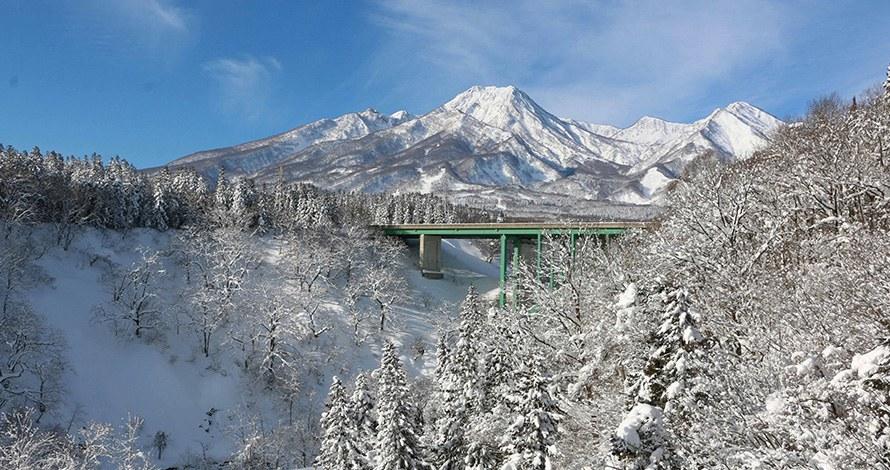
Header photo: “Snow-covered Mount Myoko above a forested valley, with a road bridge crossing the gorge” (Ministry of the Environment, Japan / 環境省), https://www.env.go.jp/nature/nationalparks/list/myoko-togakushi-renzan/spot/. Edited (cropped and resized) for use as the header image on this page. Used under the Public Data License (PDL) Version 1.0.
