Sekiyama Shrine and Its Fire Festival: Myoko's Mountain Worship Heritage
Sekiyama Shrine sits in the Sekiyama district of Myoko, at the foot of Mt Myoko. It looks like a quiet village shrine, but it was the centre of worship of the mountain for centuries. It also keeps a bronze Buddhist statue made in ancient Korea, and every July it holds a fire festival. This guide is for owners and visitors who want to understand the place before they go.
Everything below comes from Myoko City and the Myoko Tourism Bureau, read on 13 November 2026. Festival times change each year, so check the official programme before you plan a visit. This is general information only.
The shrine in brief
- Role: the Myoko Tourism Bureau calls it the satomiya, or village shrine, of Mt Myoko.
- Founding story: tradition says it was founded in 708, in the Nara period, by a monk called Ragyo Shonin.
- Address: 4804 Sekiyama, Myoko City. There is parking. You can visit at any time, but the shrine office is unstaffed.
- Buildings: Myoko City lists the main hall, offering hall and worship hall (built in 1818) and the inner shrine, or kuden (1790), as registered tangible cultural properties of Japan. Both were registered on 27 March 2018.
From temple-shrine to shrine
Until 1868 the place was called Sekiyama Gongen, and it was run together with a Buddhist temple, Hozoin. Myoko City explains the history:
- Hozoin was a temple of the Tendai school. It managed Sekiyama Gongen and held large estates.
- In the Edo period it came directly under Kan'eiji (Toeizan) in Edo, which appointed its head priests.
- The shogun's family granted Hozoin farmland worth 100 koku of rice, together with five mountains: Mt Myoko, Mt Kanna, Mt Chausu, Mt Fudo and Mt Hiuchi. So Hozoin was also a local lord, and it ran its lands through its own offices.
- It led the festivals of Sekiyama Gongen and the pilgrimages up Mt Myoko.
From 1868 the Meiji government separated Shinto and Buddhism. Hozoin was closed. Only the festival of Sekiyama Gongen survived, handed over to the shrine's parishioners as the Sekiyama Shrine Grand Festival. Most people simply call it the fire festival.
A Buddha from ancient Korea
The shrine's most remarkable treasure is a bronze standing statue of a bodhisattva. Myoko City says:
- It is a statue of Sho Kannon.
- Its shape and the make-up of its bronze suggest it was made in Baekje, a kingdom in the south of the Korean peninsula, in the late 6th century.
- Until the end of the Edo period it was the main object of worship inside the main hall of Sekiyama Gongen.
- Every year on the 17th and 18th days of the sixth month of the old lunar calendar, a festival was held in its honour. The city says this is today's fire festival.
The city's list of cultural properties shows the statue as nationally designated since 10 July 2009.
The city also notes a link with Zenkoji, the famous temple in Nagano. Zenkoji's legend says its hidden main image is a Buddha from Baekje too. So both places share a Buddha from the time Buddhism first came to Japan.
The Mt Myoko statues in the Myoko-do hall
Until the end of the Edo period, a statue group of Amida Buddha and two attendants stood in a small hall on the summit of Mt Myoko. When Shinto and Buddhism were separated, the statues were taken off the mountain. Myoko City says they are now kept in the Myoko-do, a hall built next to Sekiyama Shrine. Our guide to Mt Myoko, linked below, tells more of that story.
The old Hozoin garden
Next to the shrine is the garden of the former Hozoin temple. It was designated a national Place of Scenic Beauty on 27 March 2013. Myoko City describes it like this:
- The garden goes back to the Muromachi period, and its theme is the worship of Mt Myoko.
- Its rocks, waterfall and water are thought to picture the mountain. A group of three stones on the artificial hill stands for the Amida triad, showing the summit as Amida's Pure Land.
- A 5-metre waterfall stone arrangement faces you, with the real Mt Myoko rising behind it. The city says this contrast is rated as outstanding and unlike any other garden.
- The poet Sogi visited Sekiyama in 1478 and wrote about a garden with a waterfall at a temple lodging there.
- The garden was restored over six years, from 2015 to 2020, based on how it looked in the late 18th century.
Visiting: the garden is planned to be open from late April to late November. The city says the waterfall starts running in late April when the winter covers come off. It is stopped in late November when the covers go back on. The garden is closed in winter, and the dates can shift with the snow. Use the Sekiyama Shrine car park. The nearest public toilet is next to the shrine office, about a five-minute walk from the garden.
The fire festival
The Myoko Tourism Bureau says the festival carries on the tradition of Shugendo, the mountain worship practised by ascetics. Its programme describes it as a festival with more than 1,300 years of tradition.
The festival is held every July. In 2026 it ran on Saturday 18 and Sunday 19 July. The 2026 programme gives a good idea of what happens:
- Mock yamabushi displays: people dressed as mountain ascetics perform martial arts in front of the shrine. In 2026 primary school children went first at 10:15, then the preservation society at 10:35.
- Pine pulling: the pine-pulling (matsubiki) started at 11:00 below the drum bridge. The programme says anyone is free to join.
- Children's portable shrine: at 14:00 in the shrine grounds, open to any child.
- Evening: drums, Japanese instruments, folk dancing and bamboo flute in the shrine grounds. The folk dancing is cancelled if it rains.
- The procession: on the Sunday, the portable shrine left the shrine at 9:00. It travelled through the district, partly carried and partly by car. It reached Sekiyama Station at 17:00 and left at 18:45 to be carried the rest of the way. It returned to the shrine at about 22:00.
- Final displays: mock yamabushi displays were held at 18:15, and again at 20:00 at the crossroads by the shrine.
The programme warns that times can change as the day goes on.
The mock yamabushi staff displays (bozukai) and pine pillar rites (hashiramatsu) of Sekiyama are designated by Niigata Prefecture as an intangible folk cultural property. Myoko City's list shows they were designated on 26 March 2013.
Other cultural properties in Sekiyama
Myoko City's list of cultural properties places several more items in the Sekiyama district. They include a bronze standing statue of Amida from the late Kamakura period and a group of 36 stone Buddhas from the late Heian to Kamakura periods, both designated by the prefecture. The shrine's dragon flag is designated by the city. The tourism bureau says the flag is said to have been a gift from the warlord Uesugi Kenshin. It shows blue dragons in gold and silver thread on red wool, and measures 72 by 53 cm.
What we could not verify, and therefore left out
- The dates of the 2027 fire festival.
- Whether the Myoko-do hall and the statues inside it are open to visitors, and when.
- Whether any fee is charged to enter the Hozoin garden.
- The closing date of the garden for the 2026 season.
- Where each of the other Sekiyama cultural properties is kept, and whether they can be viewed.
Related guides
- What Is Mt Myoko? The Volcano, Its Sacred History and Climbing Safety
- Myoko Festivals and Seasonal Events by Month
More from the Journal
Browse every guide in the Myoko Kogen Journal. Our articles are general information only; check official sources before you travel.
Sources
All URLs retrieved 2026-11-13.
- Myoko Tourism Bureau — 関山神社 (Sekiyama Shrine: founding, buildings, dragon flag, garden and fire festival): https://myokotourism.jp/tourist-spots/%e9%96%a2%e5%b1%b1%e7%a5%9e%e7%a4%be/
- Myoko Tourism Bureau — 令和八年 妙高山関山神社 火祭り (2026 fire festival programme): https://myokotourism.jp/news/ (令和八年 妙高山関山神社 火祭り)
- Myoko City — 妙高山と善光寺 (Mt Myoko and Zenkoji: the Baekje Buddha, the Myoko-do and the origin of the fire festival): https://www.city.myoko.niigata.jp/docs/6709.html
- Myoko City — 旧関山宝蔵院庭園 (the former Sekiyama Hozoin garden: history, restoration and opening season): https://www.city.myoko.niigata.jp/docs/houzouin.html
- Myoko City — 妙高市の文化財 (list of designated and registered cultural properties, as of 1 April 2026, XLSX): https://www.city.myoko.niigata.jp/docs/45.html
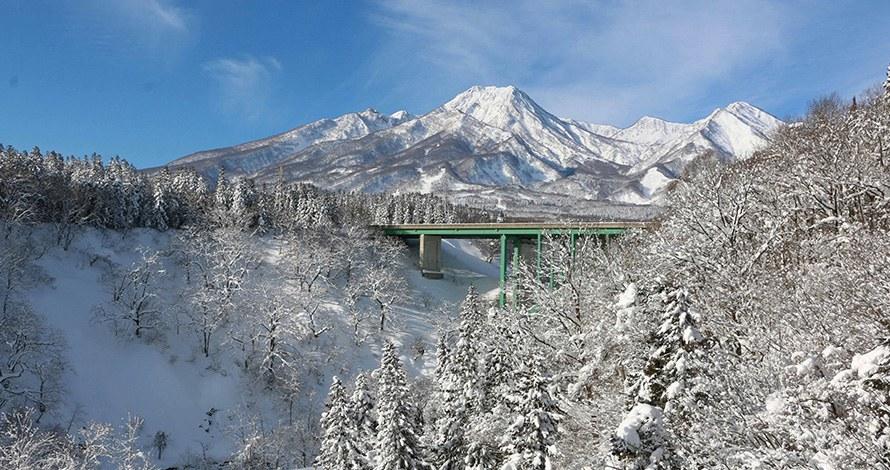
Header photo: “Snow-covered Mount Myoko above a forested valley, with a road bridge crossing the gorge” (Ministry of the Environment, Japan / 環境省), https://www.env.go.jp/nature/nationalparks/list/myoko-togakushi-renzan/spot/. Edited (cropped and resized) for use as the header image on this page. Used under the Public Data License (PDL) Version 1.0.
