How Myoko Kogen Became a Resort: Akakura Onsen and the First Ski Slopes
This guide is for people who live in Australia or elsewhere overseas and own a house in Myoko, or are thinking of buying one. It tells the short story of how a sacred mountain and a few hot springs became the resort area you know today. It covers the opening of Akakura Onsen in 1816, the hot-spring villages and villas that followed, the first skiing in 1911, and Japan's first certified ski lift in 1950.
Everything below comes from Myoko City's website and the Myoko Tourism Bureau's website, all read on 10 October 2026. We only give dates and figures that these pages state, and where a page gives two different dates, we say so. This is general information, not a full history of the area.
Before the resort: a sacred mountain
Long before anyone came to ski, Mt Myoko (2,454 m) was a mountain of worship. Myoko City says that until the end of the Edo period, a small hall to Amida Buddha stood on the summit. Its statues were made in the same style as the main image of Zenkoji, the well-known temple in Nagano.
Once a year, on the 23rd day of the sixth month of the old calendar, the temple that looked after the mountain led a pilgrimage climb to the top. In the Meiji period, the government began to separate Shinto and Buddhism, and the statues were taken off the mountain. The city says they now sit in a hall built next to Sekiyama Shrine.
1816: a feudal lord opens Akakura Onsen
The Myoko Tourism Bureau says Akakura Onsen was opened in 1816 by Sakakibara, the lord of the Takada domain. Takada is now part of Joetsu City.
Akakura sits at about 800 m. The bureau calls it the largest hot-spring village in the Myoko Kogen area, and an old spa loved by many writers and well-known people. Its water comes from a source valley called Kita-Jigokudani. The bureau says the flow is 3,000 litres a minute, which it describes as the largest in Niigata Prefecture.
Akakura is not the oldest spring in the area. The bureau says Seki Onsen was found in 1729 and has the longest history of the local hot springs. It also says full development of Tsubame Onsen, the highest at about 1,100 m, began in 1875.
1906 to 1913: Okakura Tenshin's mountain villa
Akakura's best-known early visitor was Okakura Tenshin, the art scholar who wrote The Book of Tea in English. Myoko City says he first came to Akakura on a family trip in May 1906. On that trip he decided to buy a restaurant building in Takada. In August it was moved to Akakura and became his mountain villa.
In a letter to his daughter, he wrote that the house's hot spring poured out like a waterfall, and he called the view the finest in the land. In 1913 he fell ill while in the United States and came back to Japan. That August he went to the villa to rest, and he died there on 2 September 1913, aged 50.
A hexagonal memorial hall, the Rokkakudo, was built on the old villa site in September 1959. The city says a memorial service, Tenshin-ki, is held at the hall every year on 2 September.
1912 to 1937: new hot-spring villages and villas
In the early 20th century, hot water from Akakura's source valleys was piped to new villages. The Myoko Tourism Bureau gives these dates:
- Myoko Onsen (about 550 m) began in August 1912, using water shared from Akakura. In 1917 it got its own water from another source valley, Minami-Jigokudani, and it later took the name Myoko Onsen.
- Ikenotaira Onsen (about 750 m) opened in 1924, with water piped from Minami-Jigokudani.
- Shin-Akakura Onsen (about 700 m) takes its water from the same valley as Akakura. The bureau's page gives two dates: it says it opened in 1923, and also that it opened in 1929 as a villa estate with hot water.
The bureau says that at Shin-Akakura, the painters Kosugi Hoan and Gokura Senjin and the novelist Kume Masao built villas. Universities and companies from Tokyo also built lodges there. In 1937, a large hotel was built on the side of Mt Maeyama. The bureau calls its modern design a symbol of Myoko Kogen.
1911: the first recorded skiing
Myoko City says people may once have slid on the snow for fun on bent bamboo, with no poles. But proper skiing on record starts with Major Lerch, an Austrian army officer. He is said to have brought organised skiing to Japan.
From January 1911, Lerch taught skiing to officers of the 58th Regiment in Takada, at Kanayayama and other places. As a final test he planned a winter climb of Mt Myoko. To practise for it, he skied on a mountain the city names as 兼俣山. The city says this is the oldest record of real skiing in Myoko Kogen. Skiers then used a single pole.
1950: Japan's first certified ski lift
For decades there were no lifts. Myoko City says most ski areas were short slopes close to the inn streets of Myoko Onsen, Ikenotaira Onsen and Akakura Onsen, and skiers had to walk up the hills.
That changed in October 1950. The city says the first lifts in Japan certified by the Ministry of Transport were built that month at two ski areas: Akakura Onsen Central and Ikenotaira Onsen Kayaba. With no long climb on foot, people of all ages took up skiing, from primary school children to older people. The city says the number of skiers grew every year after that.
The city also tells a small story from those years. In 1956, the lift company received a letter from a skier who had come from Tokyo to Akakura. On a two-seat lift, the writer got talking with a young woman. They kept seeing each other in Tokyo and later married. The company wrote back that a 22 mm steel wire rope had tied them together, so the bond would never break.
Myoko Kogen today
The bureau now groups seven hot-spring villages as the Myoko Kogen Onsen area: Akakura, Shin-Akakura, Ikenotaira, Myoko, Suginosawa, Seki and Tsubame. Suginosawa is the newest, opened in 1997. Myoko City's ski page lists nine ski areas.
At Akakura, the Rokkakudo and several memorial stones mark the site of Okakura's villa. The city says the stones were put up by his students and supporters, starting the year after he died.
What we could not verify, and therefore left out
- How Akakura Onsen grew between 1816 and the early 1900s, and who ran the first inns.
- The opening year of each of today's ski areas, other than what is stated above.
- Whether any part of the 1950 lifts still exists.
- When skiers from overseas first started coming to Myoko in large numbers.
- The year Myoko Onsen took its new name. The bureau's page gives it as Taisho 11 with 1921 in brackets, but Taisho 11 was 1922, so we left the year out.
Related guides
- Myoko Ski Areas and Snowfall: What the Official Records Show
- Myoko Beyond Winter: Onsen, Green Season and What's Changing
More from the Journal
Browse every guide in the Myoko Kogen Journal. This guide is general information drawn from public sources; it is not a full or official history of the area.
Sources
All URLs retrieved 2026-10-10.
- Myoko Tourism Bureau (妙高観光局) — 温泉 (Myoko Kogen hot springs: history and elevation of each onsen village): https://myokotourism.jp/onsen/
- Myoko City — 妙高スキー場情報 (ski areas list; Japan's first certified lift; first skiing in Myoko Kogen): https://www.city.myoko.niigata.jp/docs/106.html
- Myoko City — 赤倉と岡倉天心 (Akakura and Okakura Tenshin): https://www.city.myoko.niigata.jp/docs/62629.html
- Myoko City — 妙高山と善光寺 (Mt Myoko and Zenkoji: worship on the mountain): https://www.city.myoko.niigata.jp/docs/6709.html
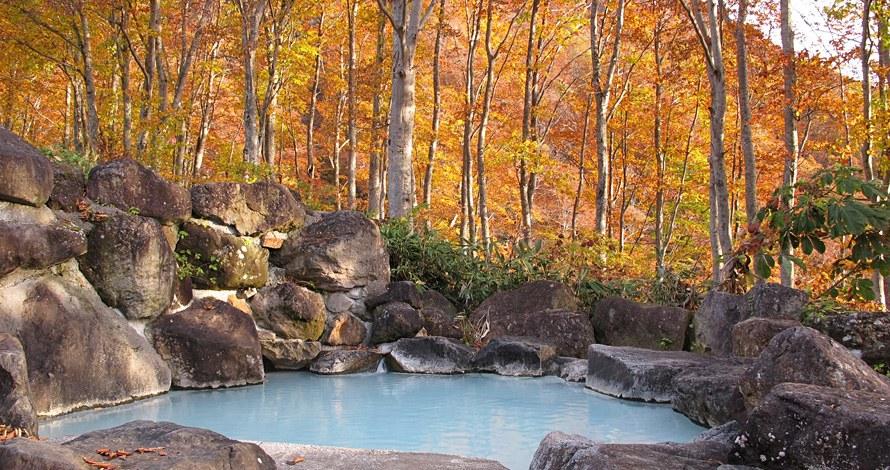
Header photo: “An outdoor hot-spring pool with pale blue water among rocks and golden autumn beech trees” (Ministry of the Environment, Japan / 環境省), https://www.env.go.jp/nature/nationalparks/list/myoko-togakushi-renzan/spot/. Edited (cropped and resized) for use as the header image on this page. Used under the Public Data License (PDL) Version 1.0.
